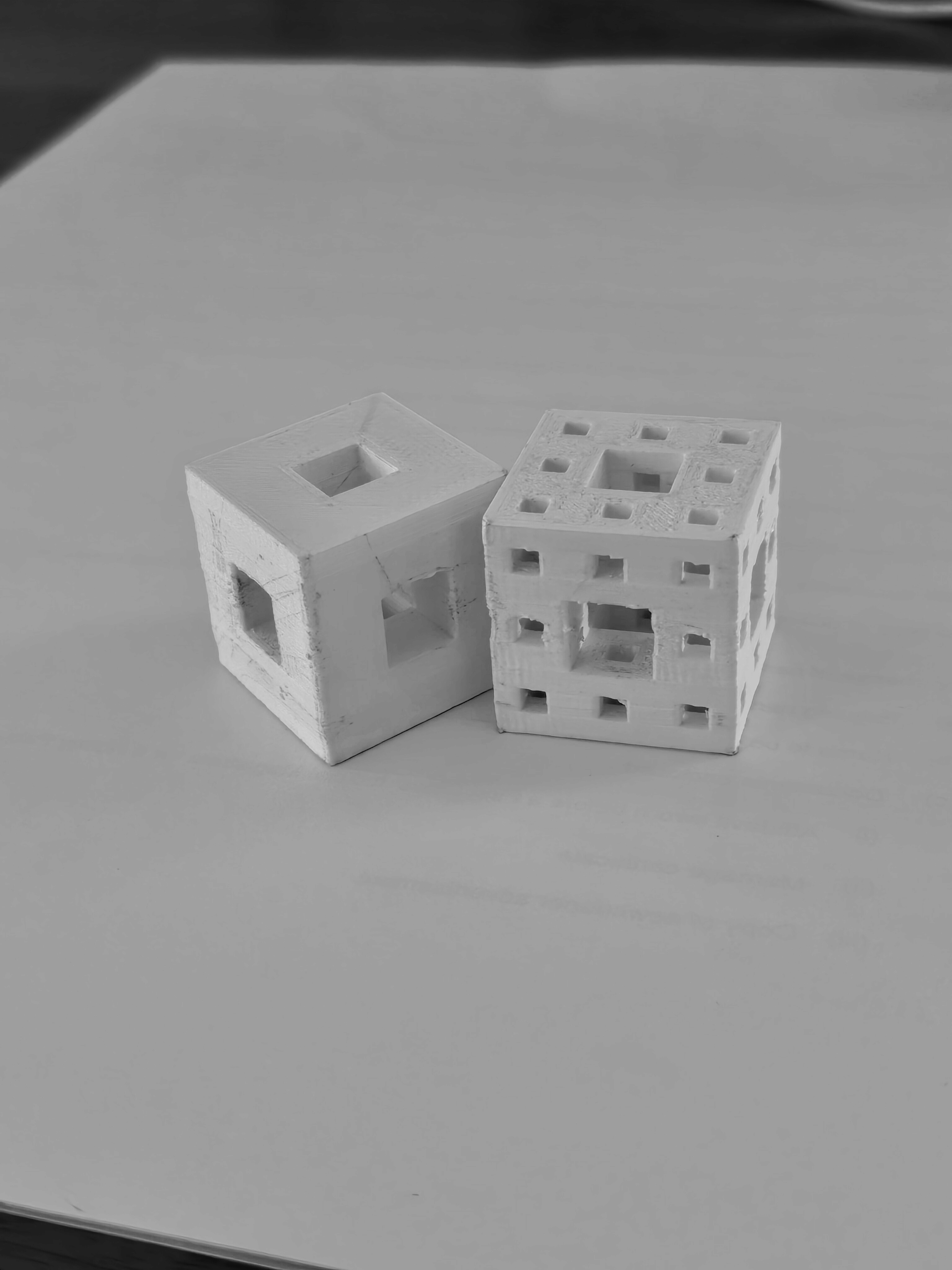
Teaching a Fractal to Withstand Pressure
Redesigned the Menger sponge architecture using PLA and PU, achieving delayed fracture and reduced energy absorption.
Reading Time
1 Min
Objective
When I began my thesis, I was intrigued by the Menger sponge, a beautifully intricate fractal structure with repeating voids and complex geometry. Previous research had already explored compression testing on pure PLA Menger sponges, revealing their weak points under stress.
My task was to take this study further, to explore whether adding a second material could improve the sponge’s fracture resistance without altering its geometry.
The Idea
I combined the stiff and strong PLA with polyurethane, which is soft and flexible. The idea was to mimic the structure like a living body with PLA as the skeleton providing stability and polyurethane as the muscles absorbing stress.
Challenges
The tricky part was ensuring the two materials worked together despite not chemically bonding. So, I used a Lego-inspired approach, printing PLA and PU parts separately and assembling them mechanically.
I designed six different prototypes using SolidWorks and 3D-printed them layer by layer. Each variation had a different internal architecture, different proportions of hard and soft regions but the outer geometry of the sponge stayed untouched.
The Breakthrough
When I tested the models under compressive loading, the results were exciting. Out of six prototypes, three showed remarkable improvement. They delayed fracture and absorbed less energy before failing.
In simple words: the redesigned sponges held their ground longer, even when pushed to their limits.
The Takeaway
I didn’t reinvent the Menger sponge, I just gave it a new behaviour. By using multiple materials within the same geometry and varying their internal architectures, I altered its performance.